ABC Stores was a chain of grocery stores that operated in Southeast Texas from about 1919 to 1973. The stores were at the cutting edge of grocery technology, but were largely forgotten after most of the chain was acquired by Henke & Pillot. The story starts with Ernest Alexander, a businessman born in 1886 in Weches, TX. Ernest had little formal schooling, only briefly enrolling in a bookkeeping course in Tyler during his teenage years; however, he was a natural at sales. His first venture into retail would be working for his father and brother, who ran a dry goods store in Teague. After a few years of this, Alexander began to look for more opportunities. In 1917, Ernst relocated to Houston and joined Gordon Sewall & Co., a wholesale grocery company. Working as a salesman, Ernest was on the front lines of a grocery revolution. The year he joined Gordon Sewall, Piggly Wiggly had arrived in Houston, and before the end of the year, the idea of self-service grocery was already exploding in Houston. For the next couple of years, Ernest would receive first-hand experience of what worked and what didn’t in this new concept. Using this new knowledge, Alexander decided to enter the grocery business for himself in Galveston in 1919. The store was a partnership between Ernst Alexander, W.D. Bell, and Edward S. Boyles. The three men would then offer $10,000 of company stock for sale, although the company would not be publicly traded. The new store would be constructed with an unusual parking lot surrounding the building, an idea from Alexander, who had predicted that women drivers would become more common and wanted to give them a reason to come to his store. Other features that made ABC stand out were its reliance on true self-service and its low-markup, high-volume model, which kept prices low.
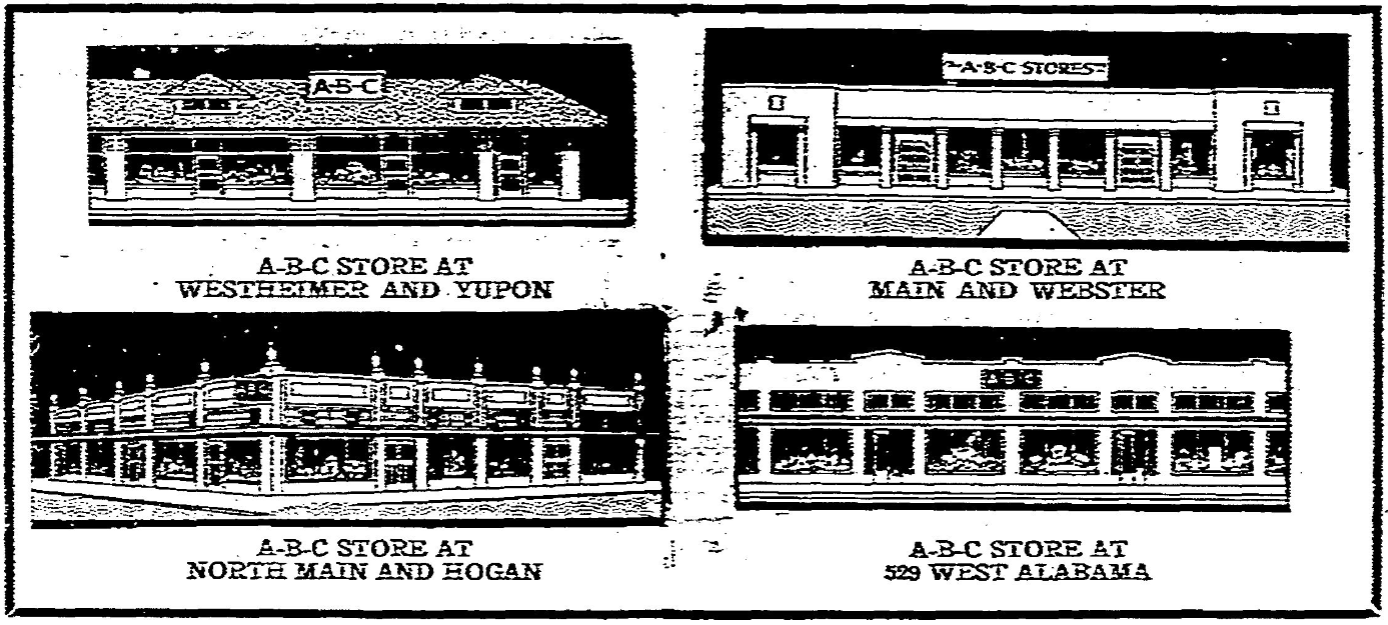
The ABC Store was not the first self-service grocer on the island, being beaten by Piggly Wiggly, but it was incredibly popular. Only a few months after opening the first store, T.O. Landrum partnered with Bell and Alexander to open an ABC Store location in Orange, Texas. With success in grocery sales in smaller communities under their belts, the opportunity to take on Houston would occur only a few months later. ABC’s popularity seemed to be on the rise, and less than a month after opening their first Houston store, ABC would open a second. This new location would be much larger than the existing stores and would incorporate leased spaces for baked goods and a butcher, a common trend at the time. ABC would specifically incorporate a leased produce section operated by a member of the Jamail family and a bakery leased to the already popular Stude’s. A third location, located on Odin Street, would soon follow, although this appears to have been a very basic store. While smaller markets had initially been the goal for ABC, Houston had quickly become its largest. In 1921, the firm would remodel its second Houston store, buying out Stude’s to operate the bakery on their own and opening a Cafeteria on the second floor, all very progressive moves that many other operators would attempt years later. In 1922, the company planned to add a fourth location to Houston, billed as the South’s largest grocery store. The store would include multiple leased departments run by familiar names at a store with 100 covered parking spots. The old store on Main would be leased to a new operator who would continue operating it as an ABC location.
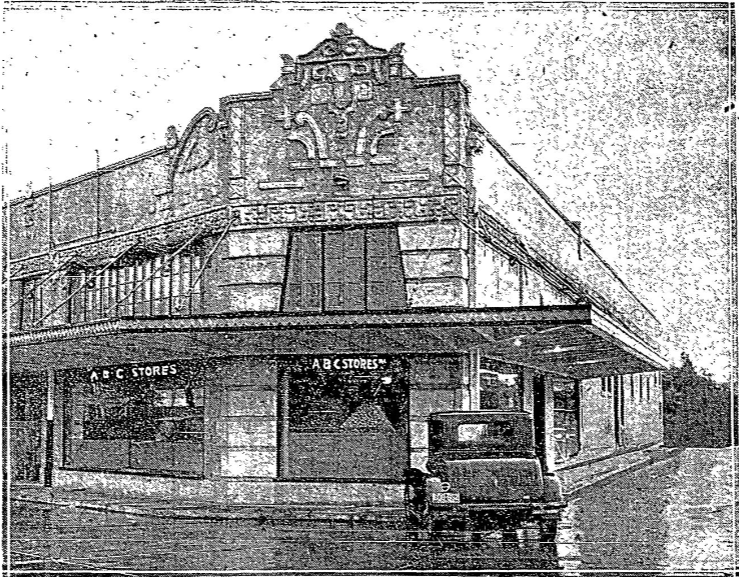
Around this time, Ernest Alexander began to pull away from ABC. While he was President of the Company, a title he had held since its incorporation, he began work on a new venture. This separate operation was a partnership between Alexander and Lonnie Bale and would operate under the Alexander-Bale name. Despite this, ABC Stores continued to expand; in 1923, an existing store, Joiner Community Market, would adopt the ABC brand. This new store was incredibly complex, featuring its own floral department, which was a rarity at the time. The store also leased space to a gas station, a drug store, and even a barber. The new store was quite the attraction, but with outside responsibilities, Ernest Alexander focused less on ABC. The remaining co-owners built a second store in Galveston, and in Orange, the Landrum family would build a new store by 1927. For most, older, smaller stores would be replaced by larger, new ones, with one exception. The huge 1922 store on Main Street was closed in 1927 when a new, smaller location opened up the street to replace it. The original store would be subdivided into multiple other businesses, as at the time, no other retailer needed such a large space. Around this time, Ernest Alexander completely divorced himself from the chain, selling his remaining shares and moving to DFW to focus on running Alexander-Bale there.

In Houston, the 1930s would prove tough for smaller grocers, with larger firms like ABC reaping the benefits. Over the next five years, ABC will open seven new stores in Houston and one in Orange. The new stores would follow Houston’s development. The most unique store of this era would open in 1932 as part of the Sears on Buffalo Drive. It was reportedly the first department store in the South to include a grocery store. The new and innovative features of ABC would not be overlooked. The stores included air conditioning, shopping carts, and shelf price tags at a time when none of these were expected. The average ABC customer was a loyal shopper, and in 1941, the ever-growing Henke & Pillot decided to capitalize on this. In March 1941, Houston’s oldest grocer purchased what it considered a complementary competitor. The sale would see Edward Boyles, one of the original co-founders, join H&P; in addition, managers and employees would be kept on, and the ABC name would remain, at least for a bit. However, by the end of 1941, Henke & Pillot began to convert locations where possible, such as their River Oaks store. The stores were converted selectively, choosing larger stores that the company felt could represent H&P and closing smaller ones. The locations in Orange would not be converted, with local partners still holding some ownership in operations there. In the meantime, the ABC name would briefly pop up in DFW thanks to Ernest Alexander, though this time, it would be for a Chrysler/De Soto Dealership he owned. The final ABC Store closed in 1973, with the sale of the remaining Orange location.
Location List
Address | Notes |
|---|---|
| 21st at Ave E, Galveston, TX 77551 | 1919-1941, Originally 2113 Avenue E |
| 304 5th St, Orange, TX 77630 | 1920-1935? Likely replaced by 5th St location |
| 930 Main St, Houston, TX 77002 | 1920-1927 Address aproximate, Long Demolished |
| 812 Preston St, Houston, TX 77002 | 1920-1922 Co-Located with Stude's Bakery |
| 2911 Odin St, Houston, TX 77020 | 1920-1926 Unsure of Details |
| 2802 Main St, Houston, TX 77002 | 1922-1927 Supposedly the Largest store in the South when it opened |
| 23rd at Ave H, Galveston, TX 77550 | 1923-1941 Demolished |
| 529 W Alabama St, Houston, TX 77006 | 1923-1935 Became and inepdent, IGA, Later Lucky 7, Still standing |
| 1340 Westheimer Rd Houston, TX 77006 | 1925-1934 Still standing, Subdivided |
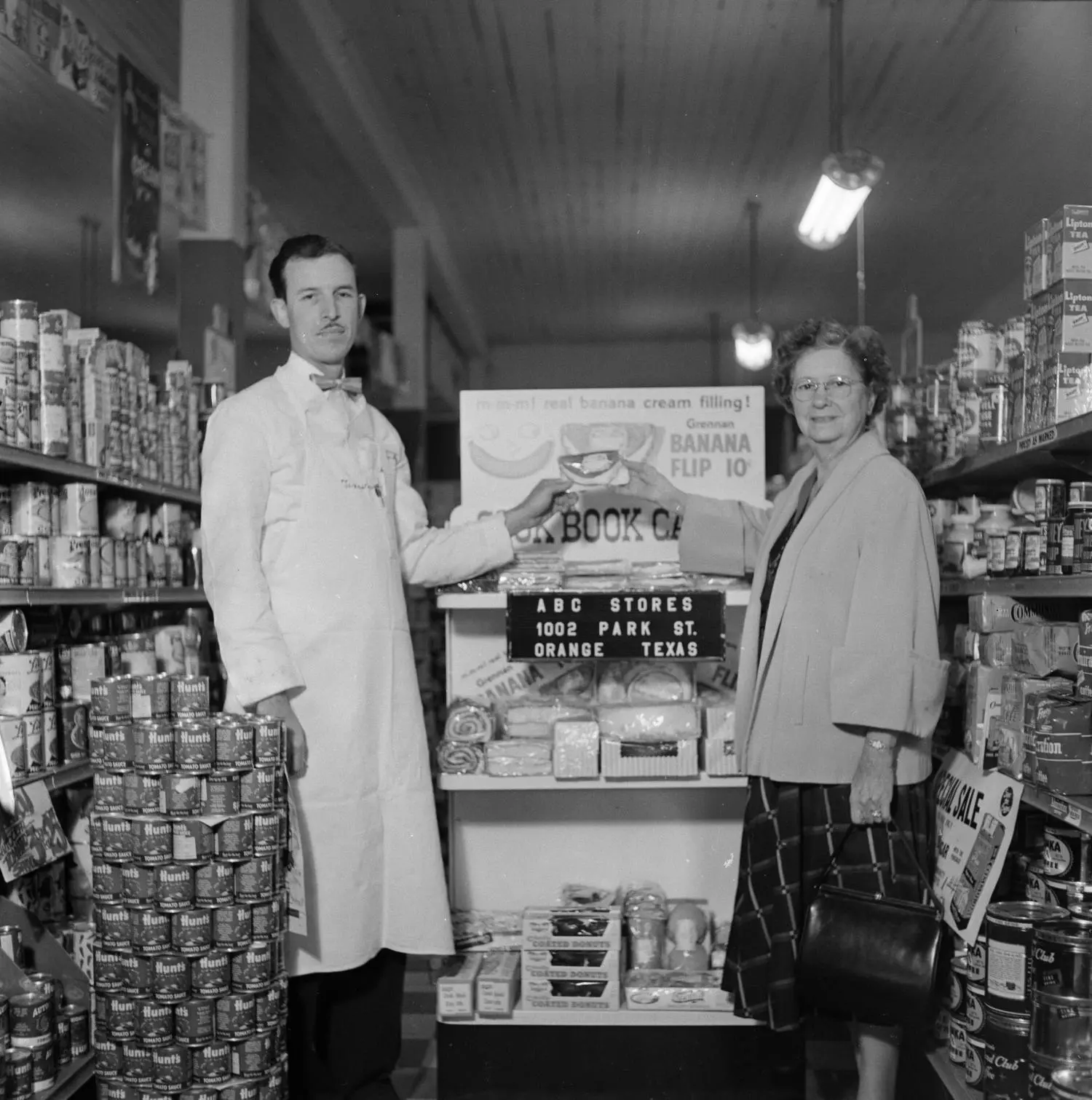
| 1002 W Park Ave, Orange, TX 77630 | 1925-1960 Still standing Alternative School as of 2026 |
| 1820 N Main St, Houston, TX 77009 | 1926-1960 Became Henke & Pillot No 9, Was used as an auction site for H&P after closing |
| 4228 Main St, Houston, TX 77002 | 1926-1953 Located across from Sears, Later H&P |
| 2200 Main St, Houston, TX 77002 | 1927-1936 Former Federated Store, |
| 6740 Harrisburg Blvd, Houston, TX 77011 | 1931-1953 Became Henke & Pillot No 11 |
| 2112 Emancipation Ave, Houston, TX 77003 | 1932-1934 Long Demolished |
| 2323 Allen Pkwy, Houston, TX 77019 | 1932-1941 Inside of Sears, Space later sublet to Baylor College of Medicine |
| 710 Telephone Rd, Houston, TX 77023 | 1933-1950 Former Alexander-Bale Store, Briefly IGA, Then Henke & Pillot No 14 |
| 904 2nd St, Orange, TX 77630 | 1935?- |
| 3414 La Branch St, Houston, TX 77004 | 1935-1951 Became Henke & Pillot No 13, Midtown Art Center |
| 1102 Yale St, Houston, TX 77008 | 1936-1954 Became Henke & Pillot No 7 |
| 2030 W Gray St, Houston, TX 77019 | 1937-1950 Became Henke & Pillot No 8, Demolished 2006 for Barnes & Noble, Original River Oaks Tennant |
| 2302 Bissonnet St, Houston, TX 77098 | 1941-1950 Became Henke & Pillot No 15 |
| 501 Western Ave, Orange, TX 77630 | 1948-1963 Previously E.P. Godwin Grocery, Still standing home as of 2026 |
| 2003 Western Ave, West Orange, TX 77630 | 1948-1973 Sold to Harold Norris |