
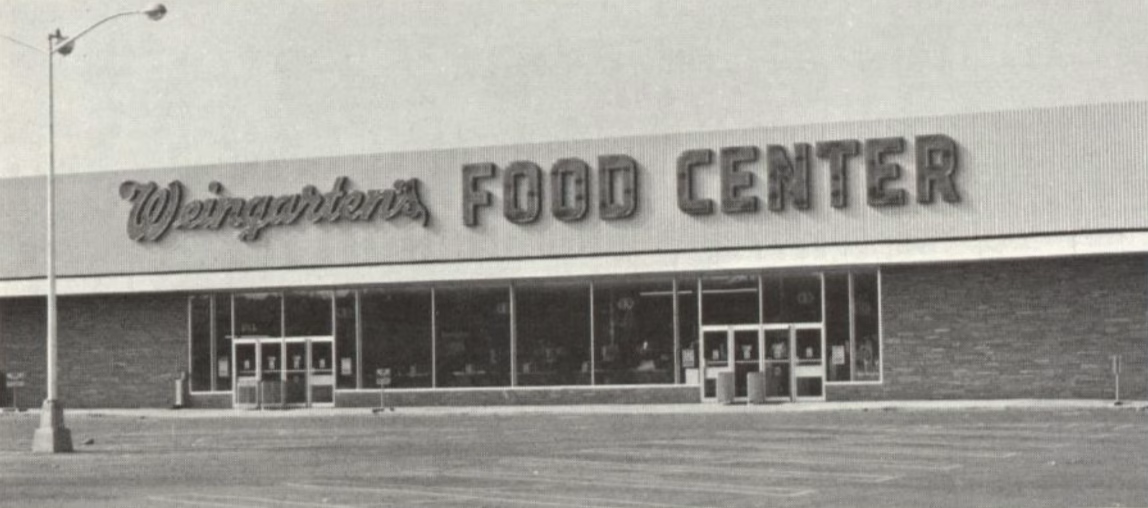
When you think of Weingarten’s, you don’t usually think of Tennessee; however, our local grocery chain had a decent presence in Memphis for a few years. While folks probably remember that Weingarten’s was not limited to Texas, the stores in Tennessee tend to surprise most. Today, we’re going to talk about how Weingarten’s got to Memphis, what they did while they were there, and how they exited. First things first, the basics of Weingarten’s are as follows. Harris Weingraten immigrated from Europe to the United States around 1880. Mr. Weingarten was one of thousands of Jewish immigrants who were trying to escape persecution. Upon arriving in New York City, Harris struggled to find lucrative work, and with family waiting in Europe, he decided to reconsider his options. Looking at the post-war South, Weingarten saw great opportunities and decided to head to Galveston. This relocation, along with thousands of other Jews, would eventually spark the Galveston Movement. Once in Texas, Weingarten tried his hand at a few unsuccessful businesses. The Weingarten family used some emergency savings to found their first grocery store in 1901. The store named H. Weingarten’s was far from the first grocery store in town, but it was a success. By this point, the rest of Harris’ family had joined him in Houston, and with all members pitching in, Weingarten’s quickly became a premier grocer in Houston. In 1905, Harris’ oldest son Joe would take over the family business, renaming the store J. Weingarten’s.
With the younger generation now in charge, the store would continue to grow, and the pace would accelerate so quickly that the Weingarten family felt it prudent to do their own real estate dealings. Now, if you’ve lived in Houston long enough, you already know where this is going. The grocery stores would eventually fall by the wayside, and real estate became the Weingarten family’s claim to fame. However, before their supermarket empire fell, it got pretty big. By the 1940s, Weingarten’s felt it was time to move outside of Houston and began opening stores along the Louisiana border, punching across state lines by the 1950s. By 1960, Weingarten’s was the dominant grocer in Houston and had a presence across East Texas, Western Louisiana, and about half of Arkansas. The chain’s real estate development and grocery arms had grown together, with Weingarten’s Realty building out new shopping centers in these areas, and reserving space for new Weingarten’s stores. Looking at other regional retailers around this time, it seems Weingarten’s was mostly taking on Kroger. Their expansion followed Kroger into more vulnerable areas, skipping DFW for Shreveport and Little Rock, smaller markets where the Weingraten’s family could own both the stores and the real estate. While this expansion was symbiotic, it did limit growth.
The Weingartens weren’t the only family to try to build up a grocery empire. In St. Louis, MO, the Molasky family had pulled off an incredible feat with their chain, Food Centers. Patriarch AJ Molasky started with a single store in 1935 and had grown to 28 locations by 1952, reaching a “saturation point” similar to what Weingarten’s had experienced in Houston. The Molasky family began looking to other nearby areas and identified Memphis, TN, as a great place to go. The city was rapidly expanding and had little grocery competition compared to St. Louis. At least originally, the plan seems to have been based around keeping the Missouri stores, although in 1953, AJ Molasky would sell Food Centers to National Tea. From what I can gather, National Tea approached the Molaskys and offered them quite a good deal to sell all 23 stores and the distribution backbone they had built. While the deal would cause a virtual reset for Food Centers, it would bring in a good amount of cash, which would help build newer, larger, and more modern stores.
In late 1953, work began on the first Food Center location in Memphis. The plan was to build out 10 locations over the next couple of years. Top Food Centers management from St. Louis would immediately move to Memphis to start this new chain. Stanley Molasky (son of AJ) would also move to Memphis the following year, after presumably finishing out a contract he had with National Tea. By March 1954, Food Centers was up and running in Memphis, and by August, they had announced their third store. By 1957, Food Centers would reach six locations, a noble feat for what was essentially a brand-new company. By the summer of that year, the Molasky family announced a deal with the Weingarten family. Weingarten’s would purchase Food Centers, but keep the Molaskys in charge. The plan was to use Food Centers as an independent subsidiary of Weingarten’s to help expand its presence across the South. They planned to keep the old name and old faces in place, but wanted to supercharge Food Center’s growth. Food Centers was close to starting work on a 7th store, which would be given to Weingarten’s to complete instead. While we don’t have exact details on how this deal was made, the Molaskys and Weingartens likely knew each other. Both were among the most prominent Jewish families in their respective areas. Under this new deal, everything seemed great. The Molaksys, who knew this portion of the South better, could help expand Food Centers, while Weingarten’s would simply provide the cash. The new stores also gave Weingarten’s much-needed access to a second distribution center in Memphis, as up until this point, stores in LA and AR had been supplied from Houston.
However, not everything in this new situation was perfect. After five years in Memphis, Food Centers had stalled out, having built six stores. For a city with exploding suburbs, this growth was lagging. Worst of all, it seems like the Molaskys realized this shortly before selling to Weingarten’s. While they had promised to stick with their old company, by 1960, Stanley Molasky and many other top execs had left Food Centers, and Jack Weingarten was relocated from Houston to try to right the ship. One of the largest problems in Tennessee expansion was a lack of land. While Memphis had tons of growth, it seems the locals weren’t too keen on the Molaskys or Weingartens taking over their territory. Upon leaving Food Centers, the Molaskys moved into real estate, but never made the splash they were looking for. Instead, the Belz, another prominent Jewish family in the area, had already made a name for themselves in property development by the start of the 50s, and may have been at least partly responsible for keeping Weingarten’s out.
In 1960, Jack Weingarten would cut the ribbon on their newest Memphis grocery store. The chain, which had been renamed Weingarten’s Food Centers, now had seven locations. He was at a turning point, encountering the same issues as the Molaskys. While the Weingartens had yet to give up their grocery empire, it was quickly becoming apparent that property development was their future. They were among the largest commercial property owners in Houston and had been experimenting with operating shopping centers where their grocery store was not an anchor. Weingarten’s didn’t own most of the locations established by Food Centers, with the exception of the newest store; the Molaskys had maintained control of the properties. Faced with this tough decision in 1961, Jack Weingarten would begin quiet discussions with the owners of Pic-Pac, a competing grocery chain in Memphis. The deal would be worked out to allow Pic-Pac to purchase five of the seven Weingarten’s Food Centers stores. This deal would exclude the burned-down location (which Weingraten planned to rebuild) and the single location the company owned outright.
While Weingarten’s Food Centers was on the way out, the family wasn’t totally gone yet. The company was considering leasing out the location they owned, which would still keep Weingarten’s foot in the door in TN. However, beyond this, there were no concrete plans for the Weingartens’ future in Memphis. Jack Weingarten remarked that he would probably move back to Houston since the grocery store’s main operations were there, and shortly after, he did. Once the burned-down location had been rebuilt, the store would be rebuilt and leased to Pic-Pac. The final Weingarten’s Food Center would close in April 1962, when it was purchased by the local firm Baker Bros. Weingarten Realty would not hold on to the property for long, likely selling it before 1970. While ultimately this Eastward expansion was a failure, it did teach the Weingartens some good lessons. Most importantly, it pushed them to move away from the comfort of owning and operating an anchor in a shopping center, which they would rely heavily on in the coming decade. Weingarten’s would return to Memphis in the 80s, working with Kroger to build some new shopping centers. While this chapter of Weingarten’s story was not the last in the grocery saga, it’s easy to see how their experience here would eventually push them away from owning grocery stores.


Love this -Mike B. I understand that Safeway operated in Memphis later, I was interested to see if that’s what happened to the Weingarten’s stores when I saw the blog entry. Very interesting that they were gone long before Safeway entered.
Hey cool, a Memphis post!
I’ll be heading across the South this summer including TN, expect to see more of the trip on Facebook.