
Jubilee City was an early discount department store chain with a brief but impactful presence in Houston. The chain is poorly documented online, and this page aims to change that. If you have any information or memories about Jubilee City, Belscot, ABC Discount, or Econo Mart, please comment below. The roots of Jubilee City can be traced back to 1955 when Lawrence Altman founded Jubilee Shops Inc. of New York. The start of the chain coincided with the development of the first modern discount stores. Existing companies like Ames, Korvette, and Two Guys were experimenting with the earliest vestiges of discount department stores in New England while other retailers watched and took notes. Altman was one of these other retailers with a background in traditional clothing sales, but saw discount department stores as the way of the future. With the backing of a few clothing manufacturers, Altman founded Jubilee Shops. The stores leased their salesfloors to the manufacturers, bypassing the standard broker system at that time. From the start, it was clear that other departments needed to be included to compete with the one-stop shopping offered by the likes of Ann & Hope, Bradlee’s, and others. To facilitate this, Altman would lease nearly every department in his stores. While it was common for stores to lease certain sections, even Wal-Mart and Kmart leased portions starting out, the number of leased departments in a Jubilee City seems to vastly outweigh most competitors. The 1950s would provide Altman with a test base of stores in the Northeast. It’s not exactly clear where these earlier stores were beyond the general vicinity of New York and New Jersey. However, it is known that with these initial stores, Jubilee cut its teeth and refined its practices. It also seems that Jubilee Shops may not have been highly profitable, but manufacturers continued to invest in the company.
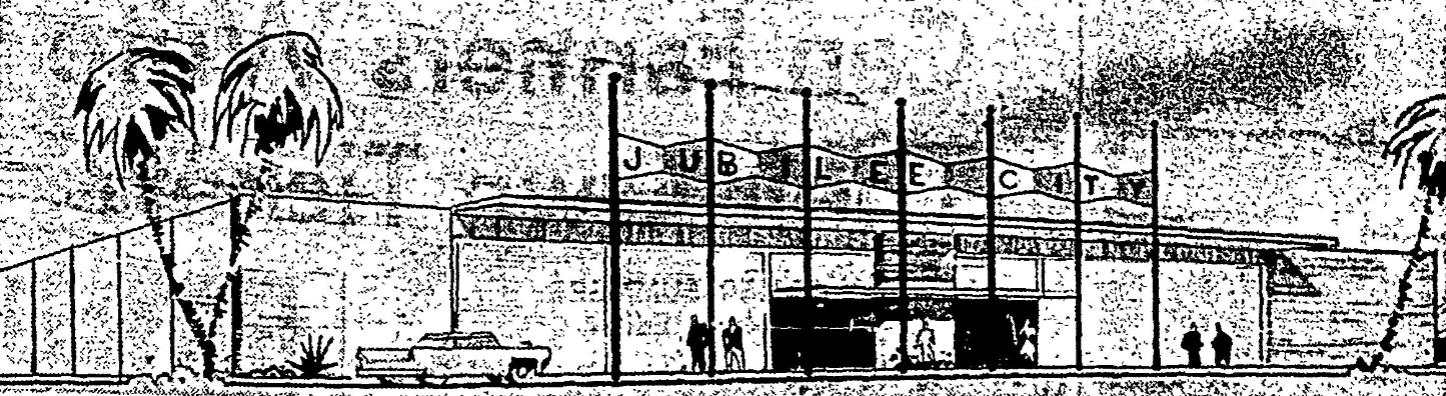
In the early 60s, the company began to expand to other parts of the nation. The focus would primarily be on the Midwest, with an additional store in Texas. The most likely cause for this expansion was the lack of discounters in these areas. While small chains like Gibson’s had a handle on smaller markets, larger towns often lacked a discounter to fit their needs. From what I can gather, Altman and Jubilee City negotiated leases across 20 different cities, often making “batch deals” to open multiple stores in an area. The main metroplexes served were Indianapolis, Chattanooga, Kansas City, and Houston. While Atlman had land, he did not have buildings, and with discounting being a low-volume business, he again had to rely on outside investment. Like in Houston, local businessmen who believed in the concept would sometimes step up. However, at least in the case of Tulsa, Oklahoma, a clothing manufacturer had to be sought out to back the construction of the building for Jubilee City. These deals seemed to have been worked out by around 1960, but construction was often quite delayed. The first announcement of Jubilee City in Houston would come on April 2, 1961 (presumably waiting a day to miss April Fools). The chain had plans and leases to construct four new discount department stores. They would be at 8201 Long Point, S. Richey, and Allendale in Pasadena, and an unnamed Southwestern side location. While the concept looked good on paper, a problem with this plan was that discount stores had been popping up in Houston since Jubilee had acquired the leases. Sage and Globe were the two most prominent chains and locals. By 1961, even Kresge was experimenting in Houston with a large-format store opening in Sharpstown Mall that year. While Jubilee City could still gain prominence, it would be an uphill battle. Jubilee City planned to one-up the competition by opening three stores by Fall 1961, and the final location would open the following spring.
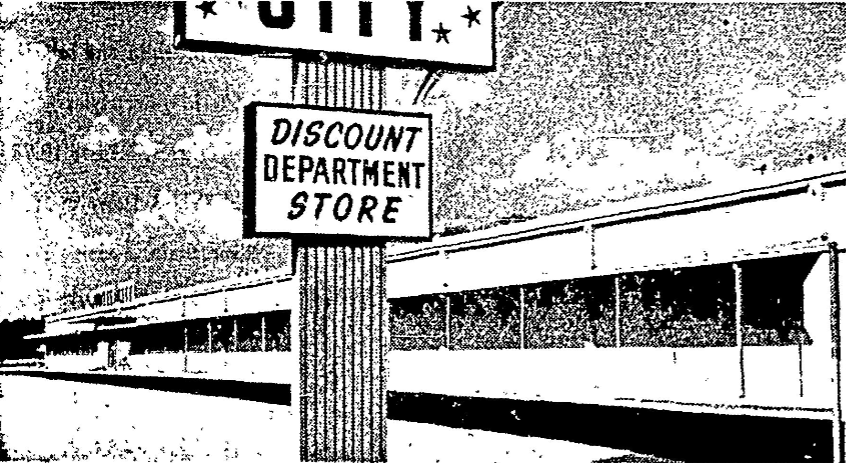
With ambitious plans and spoons in many pots around the U.S., Jubilee City brought a skeleton crew from New York to handle administrative tasks. Construction on the Eastex Freeway store was highly promoted. The building was quite advanced for the time. Due to its proximity to the planned freeway, which had not been there when the land was leased, the store ended up with the short side facing the parking lot and the long side facing the freeway. It was decided to put the entrance to the store on the short end and run the aisles along the store, making for a short number of super-long aisles. While work was quickly started on the first store, no progress was made on the others. The Long Point store was to be built adjacent to a shopping center, which held the land until Woolco chose to build there. The Pasadena store, which was supposed to be the centerpiece of a new shopping center, never started construction and was sold to a car dealer. Finally, the Southwest Houston location was never revealed, although it was said to already be under construction. This suggests the store could have been slated for Sharpstown Mall, or my theory was that it was planned for part II of the Montclair Plaza, which would eventually become Woolco. The construction story in Houston was not too different from many other metroplexes, where Jubilee pledged to build multiple stores but only ended up constructing one. Based on the land sales to Woolco in various cities, Jubilee likely sat on some of the land it owned and sold it when it needed cash a few years later. In Houston, the grand opening of Jubilee City occurred on September 21, 1961. The reception was positive, with no competing discount operations in the area, thousands turned out to see the new store.
While the neighborhood seemed to like the store, not everyone was as receptive. One of the first people to take issue with Jubilee City was City Councilman A.L. Miller, who suggested the city annex the land around Jubilee City to rein in the store for violating blue laws. Blue laws in Texas at the time were highly complex. While initially, it had kept certain types of stores completely closed one day of the week, the advent of department stores brought the concept of a 7-day operation with limited sales on one day. Everything prohibited for sale under blue laws would be off limits one day a week, with normal operations the other six days. Jubilee City, based out of New York, was likely familiar with blue laws but decided to try to skirt them. While this practice was not unheard of in Houston, Jubilee’s existence outside city limits saved them from prosecution. Still, Jubliee did not have a trouble-free existence, with a local union starting to picket the business in early 1962 due to low wages. Jubilee City would offload its Kansas City stores to competitor Gamble-Skogmo a few months later. From what I can tell, they continued to license the Jubilee City name and logo for a few years. Back in Houston, Jubilee City continued without much noise. One exception was the fining of a store manager and clerk for selling flash bulbs (a prohibited blue law item) on a Sunday. A few months later, the manager was replaced with the former manager of their San Antonio store, of which I can find no records. Over the next few months, operations would continue as usual into the summer of 1963. While the new stores were never mentioned again, it seemed like Jubilee City might have found a place in Houston until only a few days before their second anniversary, when Jubilee City suddenly announced they would be closing their doors. Only days after finally shutting down, Globe Discount City announced its plans to remodel and reopen the building as its newest location.
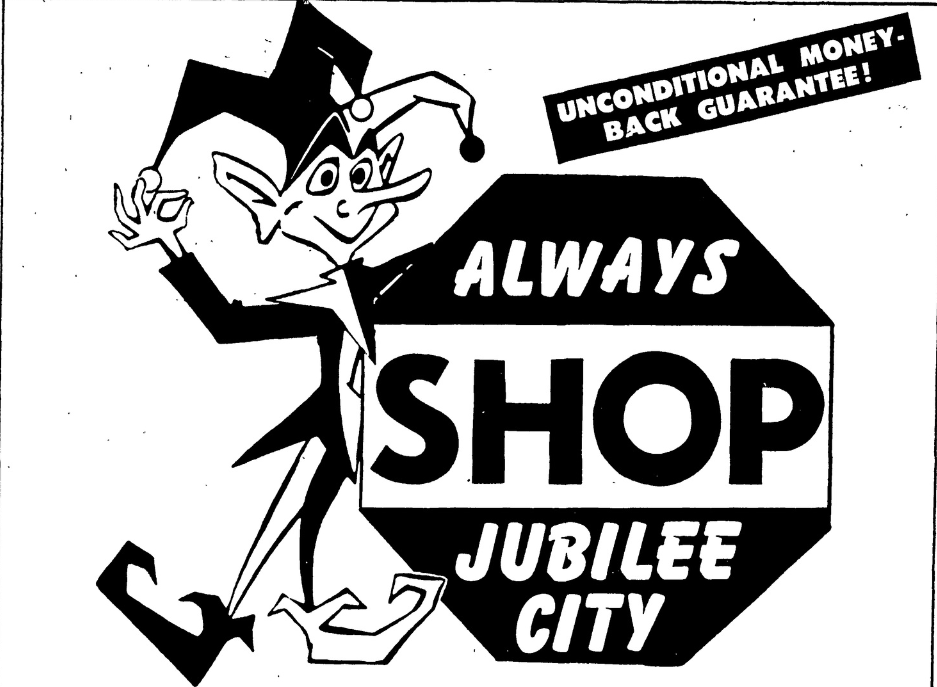
As their founder saw it, the problem with Jubilee City was competition in the big city. Big operators like Kmart, which owned all or most of their departments, had much lower overhead. On the other hand, stores in smaller towns did quite well, with competitors like Gibsons and Howard Bros operating on a similar scale. In 1968, some excess properties in Houston and out of state were sold to Woolco, which was expanding then. Jubilee City, which was likely hurting for money, merged with another company that held several discount chains. These other “sibling” chains included Belscot, Bell, Scott, ABC Discount Centers, and Econo Mart. Over time, some stores would be renamed in areas where the chains coexisted. The merger would bring together many stores, allowing the company to utilize communal buying and potentially lower operating costs. Part of making this happen would involve supplying and operating their departments, a problem the Belscot side of the chain was also trying to overcome. The problem would prove to be tricky for the chains to overcome; in addition to setting up a supply chain, basic things like contracting trucking companies would need to be done for the first time. In fact, Jubilee City’s trucking company would sue the stores after they began adding merchandise beyond apparel to their shipping lists. This lawsuit proved to be one of the final straws for the company. Being passed up by competitors like ShopKo in small towns, Belscot/Jubilee ended most of its operations by 1978.
Location List
Address | Notes |
|---|---|
| 10400 Eastex Fwy, Houston, TX 77093 | 1961-1963 Later Globe, Demolished during freeway expansion |
| 8120 Long Point Rd, Houston, TX 77055 | Planned but never built, Land sold to Woolco |
| 1831 S Richey St, Pasadena, TX 77502 | Planned but never built, Land sold to Pasadena Dodge |
| 5302 N Keystone Ave, Indianapolis, IN 46220 | 196?-1975 Subdivided, Still standing |
| 5615 Lee Hwy, Chattanooga, TN 37421 | 196?-1970 Later Gibsons & Target, Demolished around 2010 for Airport Expansion |
| 4915 State Ave, Kansas City, KS 66102 | 1960-1966 Still standing, Subdivided |
| 8760 Blue Ridge Blvd, Raytown, MO 64138 | 1960-1966 Still standing, Mostly Save-A-Lot |
| 11215 W 63rd St, Shawnee, KS 66203 | 1962-1966 Still standing, Subdivided |
| 6925 E Admiral Pl, Tulsa, OK 74115 | 1962-1970 Later Price Mart, Still standing, Subdivided |
| San Antonio, TX |

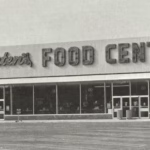
My first job while in high school in the early 70’s. Indianapolis store
B. Clark
I was born in June 1961 and my mother bought my baby clothes at the Indianapolis store there. So it had to have existed in mid-1961.
Great addition to the site. Thank you for all the research you’ve done Mike!
Thank you Jake, I appreciate your continuous readership!