
It all started with Piggly Wiggly
Minimax was a chain of grocery stores with locations in Houston and throughout Texas. Their story starts with Brenham resident E.A. Eversberg. Mr. Eversberg had become a prominent businessman in Central Texas during the early 1900s. Graduating from Texas A&M, Eversberg served both abroad and at Camp Bowie during World War I. During the war, Eversberg had become familiar with self-service grocery stores, specifically Piggly Wiggly, which he may have seen in Houston as early as 1917, only months after the concept had debuted in Memphis, TN. Watching the chain expand, Eversberg decided to capitalize by franchising a store in his hometown of Brenham. In September 1919, E.A. Eversberg opened the first Piggly Wiggly franchise in Washington County. For ten years, Eversberg operated a single store. He had recruited a butcher to lease space for a meat counter and had what could easily be considered the most modern grocery store in Washington County at the time. With the growth of the Brazos Valley, Eversberg would open a second Piggly Wiggly in Brenham in 1928. The area would continue to experience rapid population growth as people relocated from the Midwest to avoid the Dust Bowl. While Eversberg sought to capitalize on this growth, the Piggly Wiggly franchise system was strict about territorial claims, limiting Eversberg to opening stores only within Brenham. To remedy this, E.A. began courting other grocery franchises to try to get a jump on the competition. He would find his solution in Humpty Dumpty, an Oklahoma-based chain that was essentially a clone of Piggly Wiggly. Although he likely had the knowledge to recreate a Piggly Wiggly-style system, extensive copyright protections, from the shelving to the store layout, made it necessary to align with another company. Humpy Dumpty had specifically developed “stoop-free shelving” and bargain corners, creating what the courts at least considered an independent system. Eversberg was so confident in Humpty Dumpty that he purchased master franchise rights for almost all of Texas.
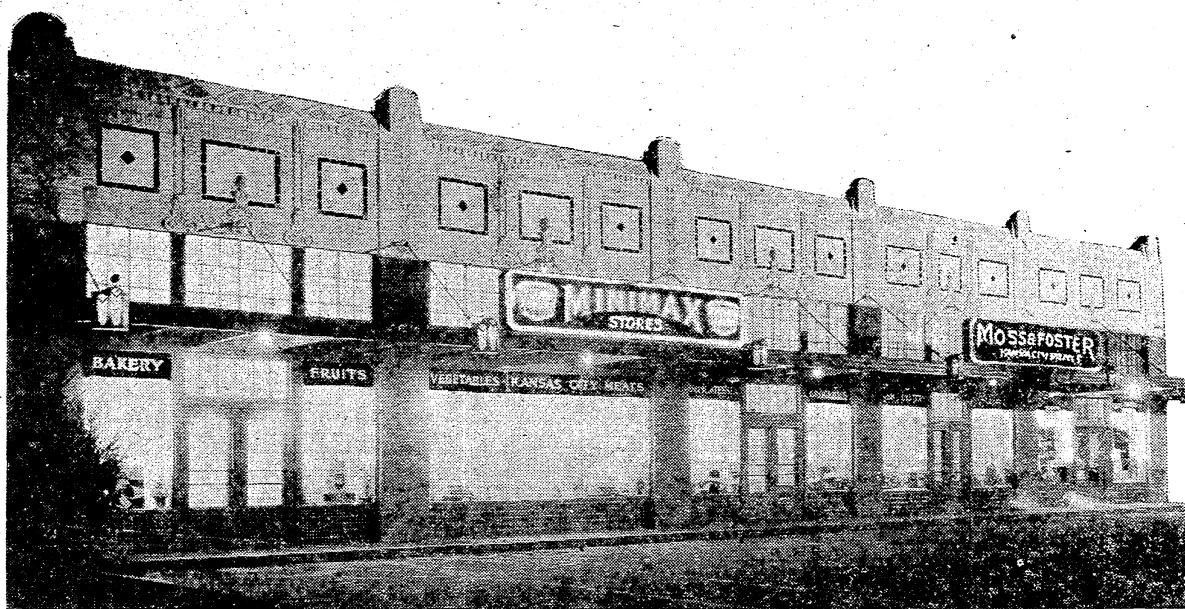
In 1929, after ten years as a Piggly Wiggly operator, E.A. Eversberg announced he would flip his first Brenham store to a Humpty Dumpty. The store would be retrofitted to use the new Humpty Dumpty system, removing the old fixtures from Piggly Wiggly. Likely due to contractual reasons, Eversberg would continue to operate his second Piggly Wiggly as usual. As Humpty Dumpty’s master franchisee in Texas, Eversberg would be responsible for recruiting new franchisees, in addition to operating his own store. In this role, Eversberg would be entitled to a percentage of each franchisee’s profits. However, Eversberg earned no revenue from the sale of fixtures to the new franchisees, a significant source of cash for advertising and other executive functions. Always the astute businessman, he began developing his own franchise system, including a fixture-manufacturing facility in Rockdale, Texas. In 1931, the first Minimax stores opened throughout small Texas towns. With Eversberg controlling the fixtures and royalties, he was able to set low rates and transfer planned Humpty Dumptys to his new Minimax System. Back in Brenham, when the butcher who leased space at Humpty Dumpty left to operate a Cafeteria, Eversberg decided to take over operations of the butcher counter, a rarity at the time. By this point, Eversberg owned more than a few Minimax and Humpty Dumpty locations throughout Central Texas, and it seemed that E. A. felt he was finally ready to compete with the “big boys” in Houston. The first Houston store was built in the “suburb” of Montrose and was considered the most advanced grocery store in suburban Houston at the time. Many early shoppers made comparisons to Weingarten’s and Henke & Pillot. Residents of Brenham compared the store to their local Humpty Dumpty, suggesting that Minimax could be considered a copy of, a copy of a Piggly Wiggly. The Houston location would include a leased butcher counter, bakery, and a wide array of groceries. Despite Minimax’s flagship store being in Houston, Eversberg vowed to remain in Brenham.
As noted on many other pages on HHR, although the Great Depression had a measurable impact on Texas, certain areas were less affected than others. Houston was able to largely scrape by, funded by a growing oil & gas industry. Despite hardships, Houston also experienced growth during the Depression. Minimax opened its second store in July 1932 in a former Alexander-Bale store, a chain that had not been as lucky during the Market Crash. Additional stores would continue to open in other areas of Texas where growth had been observed, such as Newgulf. With Houston doing well in the 30s, robberies of retailers by traveling criminals became common, with profitable stores like Minimax even attracting robbers from out of state. Despite operational difficulties, the Houston Minimax stores proved profitable. One of Everberg’s most significant advantages was his relationship with Schumacher Co., his supplier since the Piggly Wiggly days. Schumacher began in La Grange and expanded to serve many small towns, serving as the primary supplier to Humpty Dumpty and later to Minimax. Much of Minimax’s success was attributed to its suppliers and to its ability to provide fresher foods than competitors. To maintain this reputation, Schumacher would be well advised to expand its presence in Houston to support an ever-growing Minimax. In 1935, Eversbreg planned for Joseph Finger to design a new store at Milam and Gray. This building would not only house a full grocery store but also sublet space to Walgreens and include air conditioning. It was clear with this new store that E.A. was genuinely ready for the big leagues, and he opened his fourth store in town just a year later. To address the responsibility of operating the increasingly complex Houston Minimax stores, Eversberg gradually sold his Humpty Dumpty locations and converted the Brenham location into a Minimax. Despite past assurances, sometime around 1938, E.A. and his family leased out the Brenham store and moved permanently to Houston. In 1939, in what was likely a direct response to Weingarten’s, who had started a similar program, Eversberg opened a barbecue and poultry plant. The plant would prepare fresh barbecue and roast poultry daily, which would then be sent to stores and sold directly to customers. Eversberg had dedicated his life to Minimax, and his efforts were apparent. However, he had his eye on a broader picture, and around 1940, he sold both Minimax and Humpty Dumpty to Schumacher in preparation for a possible American entry into World War II.
Schumacher buys Minimax and doubles down
Although coverage of the sale was limited, its occurrence coincided with the start of World War II and Everberg’s enlistment in the National Guard. He relocated to San Antonio, from where he would be called into active duty just over a year later and months before the attack on Pearl Harbor. With E.A. entirely out of the picture (he would once again have an impactful career in the European theater of the war), the fate of the chain lay in the hands of its supplier, John Schumacher. As a wholesaler by trade, it was apparent that Schumacher had operated at least a few grocery stores. However, they were mostly small stores in country towns. Houston was likely a new experience for the man from La Grange, who would experience some of the same pitfalls as Eversberg. Despite these early hiccups, Schumacher was able to quickly grow both Minimax and Humpty Dumpty over the next few years. Around this time, the Humpty Dumpty identity began to fade, likely due to a merger the original Oklahoma-based company had undergone shortly earlier. While Minimax had been used all over, Schumacher planned to restrict the Minimax name to modern supermarkets, leaving some smaller country stores aligned with I.G.A. for branding. While Schumacher would continue supplying the smaller stores, the company’s focus would be on expanding Minimax in Houston. In 1946, Minimax would debut its first 24/7 grocery store. Offering a unique service at the time, the stores would be open 24 hours a day, 7 days a week, every day of the year. It was a new concept, but the innovations that had prompted Eversberg to build his own chain were among the reasons Minimax was successful. Despite some early hiccups, the risk proved successful enough to warrant a second 24-hour store in Houston just about a year later. To support this consistent expansion, in 1947, Schumacher began work on a massive new $1 million warehouse in Houston. By 1949, Minimax had expanded to 11 company-owned locations in Houston and a similar number of franchised stores in the Houston suburbs, making it one of the larger grocery chains in Texas at the time.
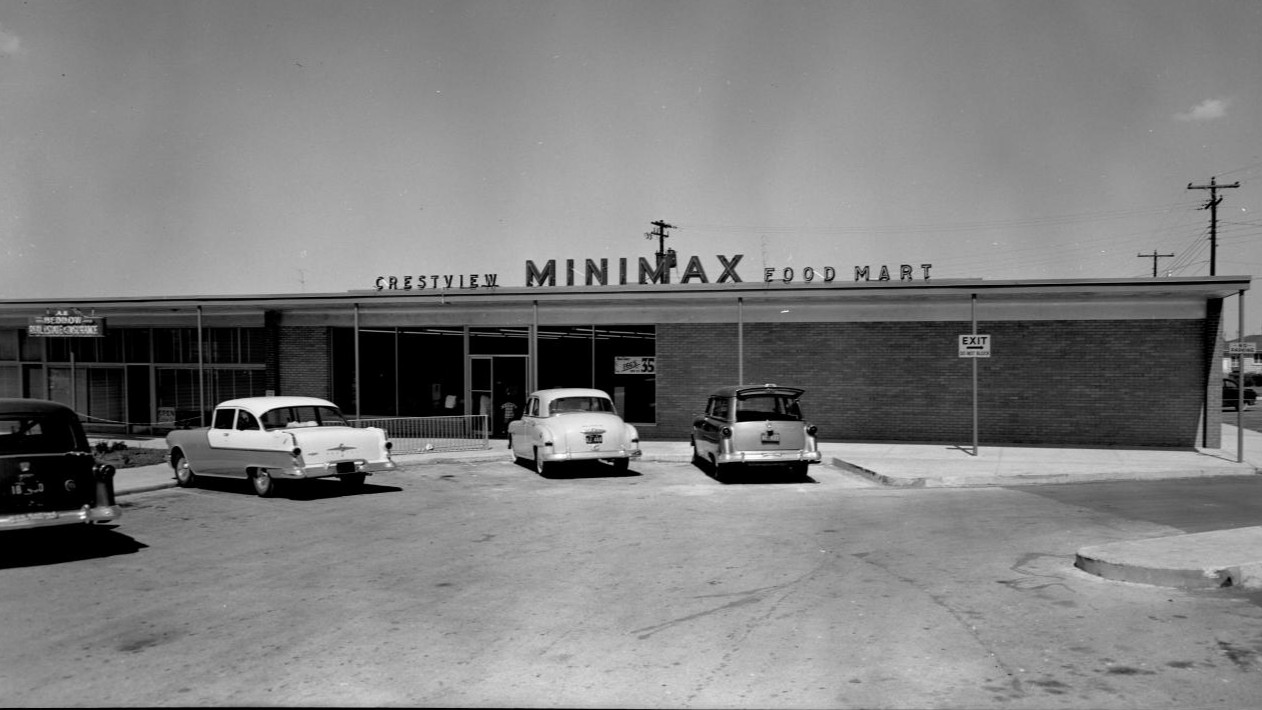
Taken from Douglass, Neal. Crestview Minimax Food Mart, photograph, August 15, 1956; (https://texashistory.unt.edu/ark:/67531/metapth33127/: accessed April 10, 2019), University of North Texas Libraries, The Portal to Texas History, https://texashistory.unt.edu; crediting Austin History Center, Austin Public Library.
Under new ownership, Minimax had become enormous during the 1940s. However, this was still only the tip of the iceberg for the grocer. While Schumacher had done a great job at running the Houston stores, at its heart, Minimax was still a co-op, and Schumacher was still just a supplier. With the Baby Boom starting at the end of World War II, the chain needed to grow faster than ever, and Schumacher wasn’t up to the task on his own. As mentioned previously, Minimax had primarily been focused on the city. However, smaller towns required supermarkets, and they would fill them, with or without the assistance of Minimax. Schumacher observed that a quick way to increase store count would be to sign on existing stores in new territories. The first location to meet this criterion was Barber’s Market in Conroe, which retained family ownership but joined the Minimax system in 1951. Over the next few years, Minimax stores would open in any location where Schumacher operated in Texas. New stores were primarily concentrated in Houston, the Gulf Coast, and Austin, although stores were known to exist as far North as Killeen. New franchisees were also recruited in Houston, and as the city’s boundaries expanded, the distinction between company-owned and franchised stores was becoming blurred. It appears that around the mid-50s, Schumacher began to sell off the remaining company-owned Minimax locations, shifting primarily to a franchise-only system. Some of this push seems to have been to facilitate the Florian family. A long line of grocers who had worked for other chains (mainly Weingarten’s and H&P) and decided to go out on their own as a family and take hold of Minimax. While they would never gain corporate control of Minimax, the family would take over the remaining company-owned stores and majorly influence the chain’s business. As Schumacher transitioned out of direct retail, the focus shifted to building and maintaining properties for “store owners” to lease. The supplier would set an ambitious goal of jumping from 40 locations in 1958 to 75 by 1975. To facilitate this rapid growth plan, Minimax would begin opening new stores for franchisees. Schumacher would even sign leases in new shopping centers where they did not have a franchisee signed on because they knew they would be able to find owners. Although unknown to the public at the time, these decisions would be among the last made by Schumacher.
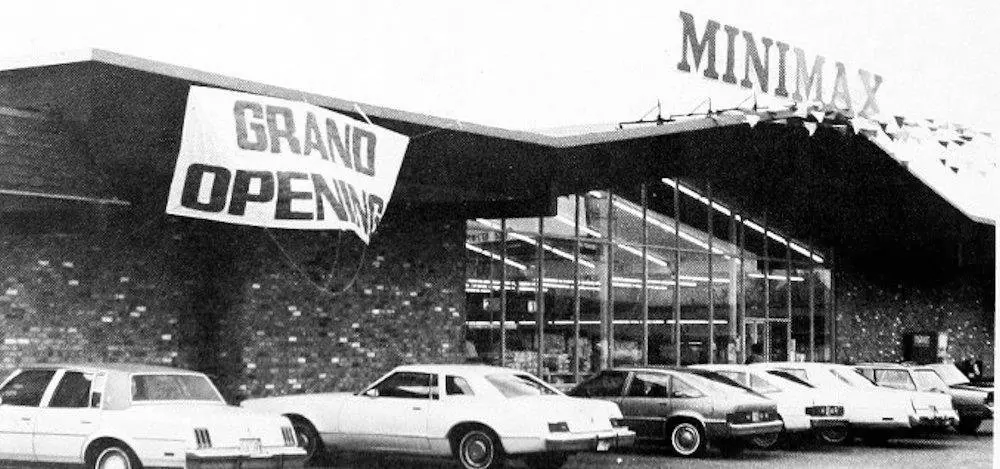
In April 1960, Schumacher Co. was acquired by wholesale competitor Fleming. While the plan was to dismantle Schumacher eventually, Fleming realized that the company’s core was its Minimax and IGA operations, which consisted of about 250 stores. As such, one of Schumacher’s final actions was jointly hosting a “roundup” with Fleming. Higher-ranking franchisees would be invited to meet the Fleming executives and learn about upcoming changes. Houston was undergoing rapid change at the time, and Minimax needed to adapt to keep pace. The Houston grocery market had become quite tense due to increasing national competition, local chains, and slower growth than in the 50s. While the early 60s would see a continuation of the Schumacher plan to build and lease new suburban stores, a new opportunity would present itself after only a few years. While Minimax struggled to compete with national chains, it kept pace with local competitors and often outsold other independents. In the 1960s, Minimax stores started to deviate from their earlier counterparts. While Schumacher had allowed variation among stores, this appeared to increase under Fleming. Some larger Supermarkets would still be built. However, many smaller independent markets could flip to Minimax after this change. The increased business led Fleming to begin construction of a new warehouse, distribution center, and bakery in 1966. The bakery would be only the second in the Fleming operation, which then extended north to Nebraska. The chain continued to expand throughout the late 60s, both through acquisitions and by opening new stores. However, the late 60s brought serious economic woes to Houston for the first time in nearly 30 years and undermined considerable confidence. While Minimax planned to build twelve stores in 1968, development would slow around this time. A significant factor in this slowdown was increased competition among supermarkets in Houston. With new competitors, such as Handy Andy, Safeway, and Eagle, planning to enter the market, Minimax was starting to appear quite basic by comparison.
The Grocery Wars begin to shred Minimax apart
The 1970s would be pretty rough on Minimax. The increased competition would constitute the first real onset of the grocery wars, and, while not the most severe we would ever see, this decade would hasten the demise of the independent grocer market in Houston. As competition intensified, it was common to see families like the aforementioned Florians exit the grocery market. The conditions in Houston were not unique either and would extend into most of Fleming’s operating territory. With corporate support spread somewhat thin during this period, Minimax operators were somewhat left to fend for themselves. Especially when an owner would exit the market, it was common for another, more established Minimax operator to try to take over the fallout. This conglomeration would eventually lead to a small pool of owners holding most Minimax locations. In addition to ownership changes, many stores that had joined Minimax from another co-op left when their contract ended. Although many stores were leaving, Minimax Fleming was able to secure a few new clients, such as Texas Super Foods. By 1978, the chain had been reduced to approximately 35 locations across Southeast Texas, of which only about 19 were in Houston. A large portion of Fleming’s business was devoted to supplying ever-growing chains such as Randalls. Even as Minimax continued to shrink, Fleming continued to support the co-op through advertising and promotions, such as S&H Green Stamps, which were almost entirely abandoned by most national chains at the time. Still, faith in Minimax was declining, and some of the larger owners began experimenting with moving away from the banner altogether. Continental Finer Foods, a long-term Minimax operator, opened its first “Finer Foods” store in 1975 and moved away from Minimax altogether over the next few years. By the end of the 1970s, however, Fleming seemed to stabilize somewhat.
One of Fleming’s long-term issues was the failure to update its stores. Some Minimax operators had added features such as delis and bakeries to their stores, but most were basic, small grocery stores. Again, this problem spread to other Fleming divisions, and by 1980, the wholesaler appeared to have received the message. They began debuting new, larger-format stores, doubling average sizes from about 20k Sqft to 40k Sqft. While they did not set any requirements, these larger stores led store owners to add service departments. In 1982, Minimax President Ray A. McBride died. McBride had been with the company since the Schumacher era and had initially been a store owner. He was essentially the glue that held the entire Minimax organization together towards the end and was not officially replaced. While Fleming would continue to supply Minimax stores and promote the chain, management appears to have been outsourced to Fleming’s Kansas headquarters. This was the final straw for Minimax as a chain, and shortly thereafter, Holiday Foods would spin off from Minimax. The remaining Minimax stores would slowly close over the next few years. The few remaining Minimax locations had little against the many other independent or chain grocers in Houston at the time. The final Houston area Minimax seems to have closed around 1994. During this time, many local grocers had pulled away from Fleming, with the most famous case being Randall’s switch to self-supply. In 1996, the Houston Fleming Warehouse and Offices would close, ending Minimax’s remaining operations. A handful of rogue Minimax stores continued to operate on their own into the 2000s, with a few even outliving Fleming. The final known Minimax closed in Austin in 2016, ending the name nearly 100 years after E.A. Eversberg opened his first Piggly Wiggly.
Location List
Address | Notes |
|---|---|
| 1200 Westheimer Rd, Houston, TX 77006 | 1931-1937 Original store, Relocated |
| 1019 Westheimer Rd Houston, TX 77006 | 1937-1972 Company Owned, Relocation of First Store, Later Jamail's Minimax, Demolished |
| 5216 Almeda Rd, Houston, TX 77004 | 1932-1949 Company Owned, Former Alexander-Bale Store, Recently Demolished, Walgreens still there |
| 12661 Market St, Houston, TX 77015 | 1950-1960 Seems to have closed after "faked" robbery was taken to court, Handy Dandy Minimax |
| 1105 East 11th Street, Houston, TX | 1935-1948 Company Owned, Sold to independent operates as Bill's, Later Thrifty |
| 711 Gray St, Houston, TX 77002 | 1937-1952 Company Owned, Later European Import Co, Yaller Moon, and Bert Wheeler |
| 2014 Clinton Dr Galena Park, TX 77547 | 1947-Present Originally Middleton's Joined Minimax in 1948 as Whisenant's, Left for Lucky 7 in 50s as Middletons |
| 220 W Sterling Ave, Baytown, TX 77520 | 1950-1959 Originally opened as a King Cole Food Market (another Schumacher Brand) Converted to Pasadena Minimax, and closed shortly after to become S&H Green Stamp Store |
| 10341 Palestine St Houston, TX 77029 | 1948- Martin & Wallace Minimax 1953, McBride Minimax 1955, 1959 |
| 1300 Wayside Dr, Houston, TX 77023 | Angle & Lynch Minimax 1953, Angle's Minimax 1955 |
| 802 Telephone Rd, Houston, TX 77023 | |
| 2902 N Shepherd Dr Houston, TX 77008 | Minimax No 11 1953, Florian's #2 Minimax 1955, 1967 |
| 6919 Jensen Dr Houston, TX 77093 | Coleman's Minimax 1955,1967 |
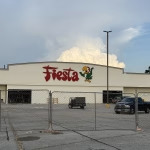
| 1100 Quitman St, Houston, TX 77009 | Now Fiesta |
| 4520 Holmes Rd Houston, TX 77033 | J.D. Jamail Minimax (Inside King Center) 1953, 1955, King Center Minimax 1959 |
| 5800 Lyons Ave, Houston, TX 77020 | Now Fiesta |
| 1001 S Broadway St La Porte, TX 77571 | La Porte Holiday Foods Minimax, La Porte Minimax 1979 |
| 1019 Westheimer Rd Houston, TX 77006 | Store #1, Company Owned December 18, 1931-, Jamail's 1953, Florian's #3 1955, 1967 |
| 10341 Palestine St Houston, TX 77029 | Martin & Wallace Minimax 1953, McBride Minimax 1955, 1959 |
| 1117 Bayou Rd La Marque, TX 77568 | Texas Super Minimax 1981 |
| 1153 Kingwood Dr Kingwood, TX 77339 | Kingwood Minimax 1976, 1981 |
| 11530 Bellaire Blvd Houston, TX 77072 | Brays Forest Minimax 1976, 1979 |
| 1201 Strawberry Rd Pasadena, TX 77506 | Strawberry Minimax 1967, Kingmart Minimax 1976, 1979 demolished after 2013 for a Stripes |
| 1204 Westheimer Rd Houston, TX 77006 | Likely original location. Built around 1930 still standing now a Slick Willie's Pool Hall |
| 1238 W 43rd St Houston, TX 77018 | Florian's #1 Minimax 1955, 1967 |
| 12512 Bellaire Blvd Houston, TX 77072 | Ferguson's Minimax/Bellford Crossing Minimax 1981 |
| 12661 Market Street Rd, Houston, TX 77015 | Built 1950, 1953 Store #2, Handy-Dandy Minimax 1959 |
| 1285 Pinemont Dr Houston, TX 77018 | King Mart Minimax, 1976, 1979, 1981 now HCC Northeast |
| 1303 Ella Blvd, Houston, TX 77008 | Continental #2 Minimax 1967 |
| 13815 S Post Oak Rd Houston, TX 77045 | Allen's Minimax 1967 |
| 1411 Ahrens St Houston, TX 77017 | Womack's #1 Minimax 1953, 1967, 1979 |
| 1424 Spring Cypress Rd Spring, TX 77373 | Spring Minimax 1976, 1979 |
| 1719 Garth Rd Baytown, TX 77520 | Texas Superfoods 1979,1981 Now a furniture store. |
| 1728 W Mt Houston Rd Houston, TX 77038 | Clayton's Minimax Opened 1978 still open in 1983, Amato's Minimax grand opening 1981, Now a Fiesta |
| 1813 Center St Deer Park, TX 77536 | Plaza Minimax |
| 18518 Kuykendahl Rd Spring, TX 77379 | Village Green Minimax 1980-1985 Wheat's Minimax 1985-1986, Later Salvation Army then Kroger |
| 2014 Clinton Dr Galena Park, TX 77547 | Whisenant's Minimax 1953 |
| 219 N Taylor St Alvin, TX 77511 | Stanton's Minimax 1967, 1979, 1981 Still Open without the Minimax name! |
| 220 West Sterling Pasadena, TX | Whisenant's Minimax 1955 |
| 2410 Bay Area Blvd, Houston, TX 77058 | Barne's Minimax 1981 |
| 2540 E Broadway St Pearland, TX 77581 | Pearland Minimax 1967/Texas Super Minimax 1981 |
| 2555 Gessner Rd Houston, TX 77080 | Kyle's Minimax was previously a Gerland's |
| 2601 Cartwright Rd Missouri City, TX 77459 | Hopper's Minimax Open in 1986, possibly in 1992. Previously a Gerland's now a gym. |
| 2728 Texas Ave Texas City, TX 77590 | Texas Super Minimax 1979 |
| 2801 Palmer Hwy Texas City, TX 77590 | Texas Superfoods (Did not use Minimax Name) |
| 2902 N Shepherd Dr Houston, TX 77008 | Minimax No 11 1953, Florian's #2 Minimax 1955, 1967 |
| 302 Winkler Dr, South Houston, TX 77587 | Hord's Minimax 1955, Florian's #4 Minimax 1959 |
| 3020 Little York Rd, Houston, TX 77093 | Little York Minimax 1967 |
| 3102 Milam St Houston, TX 77006 | Store #3 1935-? |
| 3421 Spencer Hwy Pasadena, TX 77504 | Popp-Jones Minimax 1967 |
| 3910 Aldine Mail Rte Rd Houston, TX 77039 | Continental Minimax 1976 |
| 405 South Park | Womack's #2 Minimax 1959 |
| 4520 Holmes Rd Houston, TX 77033 | J.D. Jamail Minimax (Inside King Center) 1953, 1955, King Center Minimax 1959 |
| 519 Jackson Ave Pasadena, TX 77506 | A&G Minimax 1979, 1981 |
| 5109 Fulton St Houston, TX 77009 | Joe Di Chiara Minimax 1955 |
| 5216 Almeda Rd Houston, TX 77004 | Company Owned July 30, 1932- |
| 5321 Westheimer Rd Houston, TX 77056 | Minimax Foodliner 1955, Lamar Terrace Minimax 1959 |
| 5472 Bellaire Blvd Bellaire, TX 77401 | Bellaire Minimax 1959 |
| 5550 North Freeway Houston, TX 77076 | Martin’s Minimax now a 99 Cents Only Store |
| 5817 W Airport Blvd Houston, TX 77035 | Westbury Minimax 1967, Barne's Westbury Minimax 1976, 1979 |
| 603 S Friendswood Dr Friendswood, TX 77546 | K.U. Davis Minimax 1967? Mitchell's Minimax 1979 |
| 620 W. Shaver Street, Pasadena, TX 77506 | 1950 |
| 6919 Jensen Dr Houston, TX 77093 | Coleman's Minimax 1955,1967 |
| 6935 W Bellfort Blvd Houston, TX 77035 | Wynn-Warren Minimax 1967 |
| 711 W Gray St Houston, TX 77019 | 1950 Store #4 |
| 7925 Katy Fwy Houston, TX 77024 | Continental #1 Minimax 1967 |
| 820 S Oak St La Marque, TX 77568 | Texas Superfoods Minimax 1981 |
| 850 Maxey Rd Houston, TX 77013 | Maxey Rd Minimax 1981 |
| 8540 Broadway St Pearland, TX 77584 | Dell's Minimax 1979 |
| 8622 Irvington Blvd Houston, TX 77022 | 1961-2013 Originally Berry Road Minimax, Later Carmona's Minimax, Then aligned with Festival |
| 9101 Long Point Rd Houston, TX 77055 | Miller's Minimax 1955 |
| Alta Loma, TX | Tombrella Minimax 1967, Santa Fe Minimax 1979 |
| Cleveland, TX | Cleveland Minimax 1981 |
| Conroe, TX | Barber's Minimax 1953 |
| Dickinson, TX | Bayshore Minimax 1967 |
| 1535 Elton St Houston, TX 77034 | Freeway Manor Minimax 1959, 1967 |
| Ganado, TX | Kucera's Minimax 1953 |
| Livingston, TX | William's Minimax 1953 |
| Leauge City, TX | Snell's Minimax 1967 |
| Memorial Drive at West Belt | Wynn-Warren Minimax 1967 |
| 20 Highway 59 Porter, TX | Porter Minimax Highway 59 at FM 1314 Possibly where Big Lots is? |
| Richmond, TX | Love's Minimax 1953 |
| Uvalde at I-10 East | Wynn-Warren Minimax 1967 |
| Wharton, TX | Sansing & Smith Minimax 1953 |
I remember the Minimax in Kingwood on Kingwood Dr at Chestnut Ridge. My Dad used to write checks for ‘over the amount’ and get cash back. When my parents were getting a divorce, I used to tell my Dad I needed to go to the store and get a few things, so I’d take his checkbook and write for over the amount and get some cash. Divorces can be a bitc* on a teenager. Thanks Dad!
I worked there in the 80’s. First place I met the late, great George Foreman!