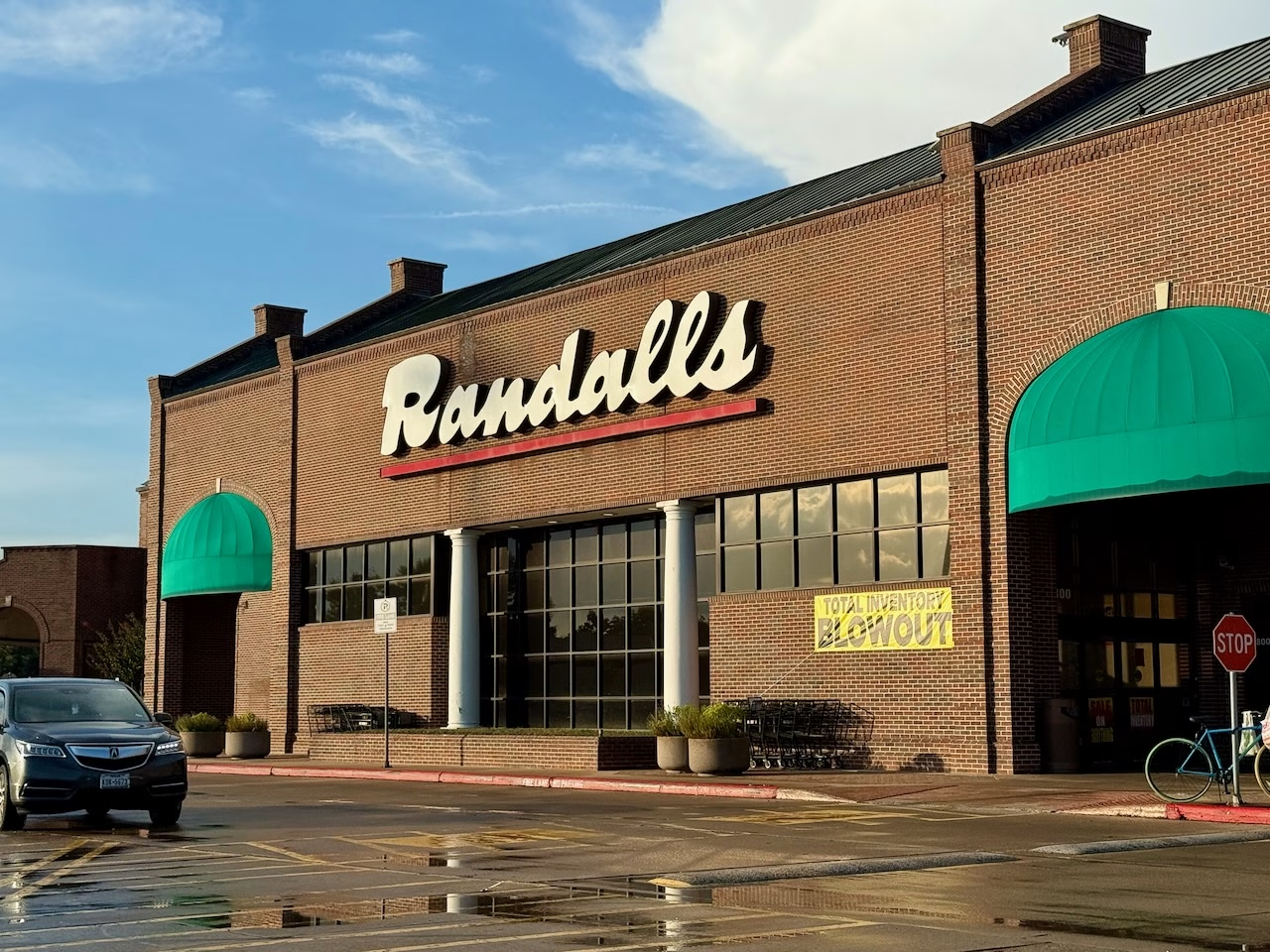
A recent comment I received on Facebook stated: “The death of Randalls should be studied for future generations.” Well, good news, I’ve already studied it! At nearly 7,500 words (about 20 printed pages), the Randalls Food Markets page is one of the projects I’m most proud of on HHR. It gained enough traction to catch the attention of Randall Onstead a few years back, who invited me to his office to meet him and discuss the write-up, which he felt was quite accurate. So I don’t bury the lede, in my opinion, no one thing killed Randalls. It was rather a series of poor decisions over many years that doomed the company. While I’m proud of the page, I understand that some folks want answers quickly, which is why today we aim to answer the question: Who really killed Randalls?
To start off, the Randalls we know today is the chain’s second go. The original dates back to around 1946 and was founded by a gentleman named AP Randall before being acquired by Blocker Martin (father-in-law of Robert Onstead). After the original stores were sold to a Piggly Wiggly operator, the Onsteads restarted in 1966. The second go at Randalls heavily emphasized discount operations at the start, eventually adding the higher-end Flagship operations after picking up the remains of Handy Andy‘s efforts in Houston. Randalls also benefited from the grocery wars, which saw the death of Weingarten’s in 1983, Eagle‘s exit in 1985, and Safeway’s spinoff of AppleTree in 1988. In each case, Randalls gained ground against the competition. Whether it was losing competition in a crowded market or taking over competitors’ stores, Randalls was “the king of Mount Houston” for many years.
So when did it all start to go wrong? Well, the earliest finger we can really point towards the downfall of Randalls is the 1992 merger of Randalls and Tom Thumb. This may seem misplaced, as Randalls and Tom Thumb are still together nearly 35 years later, but I think that by the end of the article, it should be clear that this was the first major blow. As Randalls grew, so did their aspirations. The company, which by the early 90s was the uncontested champion of the Houston area, felt the next step of its growth would be to become a regional player. To do this, though, would require logistics and management skills that they lacked. At this point, Randalls was still highly dependent on its supplier, Fleming, and Robert Onstead was still in charge of many day-to-day operations. Tom Thumb, on the other hand, had built a management and logistics system so impressive that Walmart partnered with them to learn the grocery business. It would be a best-case scenario if Tom Thumb were in need of cash and Randalls needed to update their operations. However, wary about the optics of Tom Thumb becoming a “Houston-owned” company, Randalls instead opted to essentially leave Tom Thumb to its own devices.
The next nail in the coffin was the 1994 purchase of AppleTree. As mentioned previously, AppleTree had originally been Safeway’s Houston division but was spun off as an independent company. By 1994, AppleTree was down to about 30 stores, from its high of 100. The company had not weathered the 90s well, and a revolving door of management left the stores in a sad state. In late 1993, AppleTree approached Randalls with an offer to sell them the entire company. Randalls would wisely turn this down, opting instead to pick up about half of the remaining locations. The bulk of the stores were located along the I-35 corridor from New Braunfels North to Austin. The idea was that these new locations, along with some rebranded Tom Thumb locations in the area, would provide Randalls a presence along most of the Texas Triangle. However, the reality was that these stores were dated, small, and not much different than what Safeway had been offering when they left Texas in the late 80s. With Randalls extra cash flow now directed towards Tom Thumb, these AppleTree stores never found the same level of success as their Houston counterparts. One quirk of these stores is that they ushered in the era of Randalls selling beer and wine, as they inherited Safeway’s old licenses as part of the deal.
By the mid-90s, things were changing for the worse at Randalls, but the company was far from dead yet. While the chain was still highly regarded as Houston’s hometown heroes, the inner workings of Randalls were starting to fall apart. After two years of trying, Tom Thumb and Randalls had failed to merge cohesively, acting essentially as two separate companies running side by side. The failure of the ex-AppleTree stores to explode with cash forced Randalls to pause construction of new stores for the first time in years. Other changes in Houston’s grocery scene included a brief but intense showdown between HEB Pantry Foods and Food Lion. Kroger was also catching up to Randalls by investing in their Signature concept, which directly took on Randalls Flagship stores. Around this time, persistent rumors began to circulate that Randalls and Tom Thumb might “break up” to save themselves. The theories mostly involved schemes such as Randall’s selling Tom Thumb to HEB to recoup its losses. When discussing this portion of the page with Mr. Onstead, he revealed that the true story was that Kroger began courting Randalls around this time. While a deal would never go through, Kroger was close enough to buying Randalls that talks with the Onsteads were held, but a dollar amount could not be agreed upon.
After the failed Kroger deal, Randalls would continue looking for a suitor. Randalls would find its answer in private equity firm Kohlberg Kravis Roberts & Co., aka KKR, which would pruchase 60% of the company in 1997. KKR had a perfectly cordial relationship with Randalls at the start. The plan was for KKR to inject cash into the company and begin building new stores like crazy. However, at some point not too far along, KKR got a bit gun-shy, and in July 1999, Randalls would merge with Safeway. At this point, the Randalls and Tom Thumb operations had become more streamlined, but a stronger culture still held Tom Thumb together. Randalls had completed its first distribution center and had gradually moved away from family management. However, they had never kept pace with their competitors’ construction. With Kroger taking a jaunty first place, and HEB just starting to enter the full-sized store sector in Houston, Randalls fate was largely sealed unless Safeway decided to take immediate action. As anyone living in Houston knows, they, of course, didn’t, and over the past 27 years, we have watched Randalls fall from grace, like some long, drawn-out death comparable to Sears.
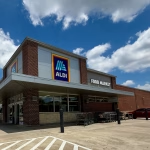
So who really killed Randalls? Well, no one person in particular. However, a series of decisions made by various groups over about 10 years led to the downfall of an otherwise great Houston institution. Randalls, of course, was not perfect, and even if none of the above circumstances had ever occurred, they would still have needed to adapt to survive. Failures like the battle of the giants with Fiesta prove that Randalls was not infallible during the Onstead days. Still, Safeway is just as culpable in the death of Randalls, and Albertsons doubly so. While we’ll never know exactly why Safeway let Randalls fall apart, the prevailing theory is that they never wanted it in the first place. While Tom Thumb and the DFW market were ripe for Safeway, the stores couldn’t be split apart, and thus, we ended up with a chain on life support. While the merger with Albertsons did turn things around for a bit, it seems like they’ve only doubled down on store closings. Will Randalls make it to 2030? We’ll just have to wait and see.